

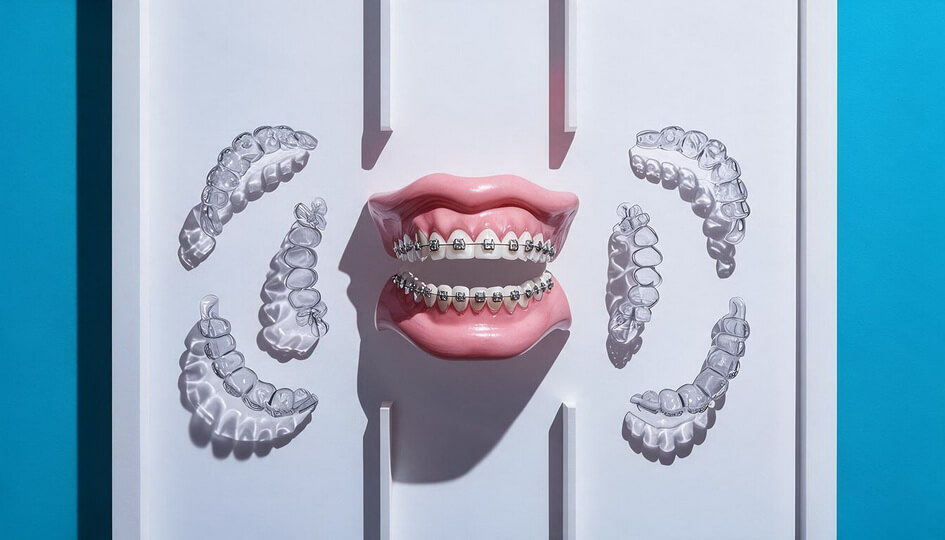
Choosing the right type of braces is one of the most confusing decisions patients face before starting their treatment journey. Although the goal is the same—a straight smile and better oral health—the path to achieving this differs significantly between clear aligners and metal braces.
There is no one-size-fits-all answer, as the best choice depends on the nature of the medical condition, the patient’s lifestyle and their budget. In this article, we will therefore outline the key differences between the two options in a clear, scientific manner to help you make the right decision.
What Are Clear Aligners? And What Are Metal Braces?
Clear aligners are transparent plastic trays made using precise digital technology to fit the patient’s teeth. These trays are worn throughout the day and removed only when eating or brushing teeth; they are replaced with new trays every one to two weeks to continue gradually moving the teeth into their correct position.
Metal braces, on the other hand, are the traditional, well-known type. They consist of metal brackets fixed to the surface of the teeth and connected by fine wires, which the orthodontist tightens and adjusts during regular monthly appointments. These wires apply constant pressure to move the teeth in the desired direction.
Both types are based on the same principle of applying controlled force to the teeth to move them; however, the mechanism of action and the patient’s experience differ significantly.
Effectiveness Comparison – Which Orthodontic Problem Can Each Treat?
Clear aligners and metal braces are not equally effective at treating all types of malocclusion; below are the main problems that each type of orthodontic assessment aims to solve:
Mild crowding (front teeth)
Moderate crowding can be effectively treated with both clear aligners and metal braces. The choice of treatment depends on the degree of crowding and the orthodontist’s plan, achieving effective results in improving tooth alignment.
Severe crowding
These cases require more complex tooth movement, and metal braces are often preferred for their ability to be precisely controlled. Clear aligners can also treat many cases with proper planning.
Gaps between teeth
Both clear and metal aligners help close gaps and improve the appearance of the smile and tooth function. The choice of the appropriate type depends on the size of the gaps and the complexity of the case.
Overbite (deep bite)
A deep bite can be treated with both types of braces by improving tooth alignment and bite. The orthodontist determines the most suitable option based on the severity of the case.
Underbite
Both metal and clear aligners treat underbites with varying degrees of effectiveness. The success of the treatment depends on the complexity of the case and the treatment plan.
Crossbite
Both types of braces help correct a crossbite and gradually return the teeth to their correct position. Early treatment leads to better and more stable results.
Severe Rotated Teeth
Correcting severely rotated teeth requires precise movement control, which metal braces provide excellently. Clear aligners can also treat many cases using advanced techniques.
Closing Extraction Spaces
Both types are used to close gaps after tooth extraction and realign the teeth correctly. Treatment duration varies depending on the size of the gap and the orthodontic plan.
Vertical Tooth Movement
Clear and metal braces can move teeth up or down to improve bite and smile. Treatment success depends on the nature and complexity of the case.
Speed of Treatment – Do Clear Aligners Work Faster Than Metal Braces?
Many patients believe that clear aligners are always faster, but this is not accurate; the speed of treatment depends primarily on the complexity of the case:
- Simple cases (6 to 12 months): Clear aligners may be relatively faster due to the precision of the digital planning.
- Moderate cases (12 to 18 months): The treatment time is similar for both types.
- Complex cases (18 to 30 months): Metal braces are often superior because they apply continuous forces that do not stop throughout the day.
Comfort and Pain Comparison – Which Hurts Less?
This is one of the main concerns patients have before starting treatment.
Clear aligners cause mild pressure for two to three days when each new aligner is fitted, but they have no sharp edges and do not cause mouth sores.
Metal braces may cause pain after each wire tightening session, and the metal brackets may rub against the cheeks and lips, causing irritation at first until the mouth adjusts to them.
In general, clear aligners are superior in terms of comfort during treatment, but they require a high degree of self-discipline from the patient.
Appearance – The Obvious Difference, But Is It a Dealbreaker?
Many patients place great importance on the appearance of their braces during treatment, which is entirely understandable.
Clear aligners are virtually invisible, making them the preferred choice for adults, professionals and students who are conscious of their appearance during treatment.
Metal braces are clearly visible, although modern brackets are smaller and less prominent than previous generations.
Ceramic braces represent a middle ground, as they are tooth-coloured, making them less noticeable than metal braces but not quite as discreet as clear aligners.
It is worth noting that choosing clear aligners for purely aesthetic reasons in complex cases may negatively affect the quality of the final result.
Cost Comparison – UK Private Prices vs. Wonders Dentistry Egypt
Cost is a key factor in deciding on treatment, particularly as the prices of orthodontic treatment in the UK are significantly higher than those offered by specialist clinics abroad with the same technical standards.
| Treatment | UK Private Clinics | Wonders Dentistry Egypt | Potential Savings |
| Clear Aligners | £2,000 – £5,500 | EGP 7,000 – EGP 20,000 | Significantly lower treatment costs |
| Traditional Metal Braces | £1,500 – £3,500 | Starting from EGP 30,000 | Competitive pricing with comprehensive care |
Compliance – The Hidden Factor No One Talks About
When comparing the two types of braces, many patients overlook a crucial factor: their ability to adhere to the wearing instructions.
Clear aligners need to be worn for 20 to 22 hours a day, and are only removed when eating, drinking or brushing teeth; studies have shown that patients who do not adhere to this may see their treatment time extended by up to 100%.
Metal braces work around the clock without any input from the patient other than attending regular appointments, making them the best option for patients who find it difficult to adhere to treatment or for teenagers.
Oral Hygiene – Which Is Easier to Maintain?
Clear aligners allow the patient to remove them to brush their teeth as normal, making it easier to maintain oral hygiene; however, the aligners themselves need to be cleaned regularly to prevent the build-up of bacteria.
Metal braces make brushing and flossing more complicated and require the use of special tools such as rigid-tipped floss or a water flosser. Furthermore, neglecting oral hygiene with metal braces increases the risk of permanent white spots appearing on the teeth as a result of metal residue.
On the other hand, care must be taken to remove clear aligners before consuming any sugary or acidic drinks, as leaving them in traps these substances directly on the surface of the teeth, causing decay.
Emergency and Follow-Up – UK vs. Egypt Considerations
One of the things to bear in mind when considering treatment outside your country of residence is to plan your follow-up appointments carefully, as orthodontic treatment requires regular visits to monitor progress, whether to tighten the wires in metal braces or to collect new aligners for clear aligners.
Wonders Dentistry follows clear follow-up protocols that take into account the circumstances of patients travelling from abroad, whilst providing ongoing communication channels to ensure treatment progresses correctly between visits.
FAQs
How effective are clear aligners for closing gaps between front teeth?
Clear aligners are very effective at closing minor to moderate gaps between the front teeth, and may be sufficient in many cases without the need for metal braces.
Which is better for a deep overbite – clear aligners or metal braces?
Metal braces are the most reliable option for deep bites, as they provide more precise control over vertical tooth movement.
Are clear aligners more painful than metal braces?
No, in fact the opposite is usually true: clear aligners cause only mild, temporary pressure, whereas metal braces may be more painful after tightening appointments.
Can clear aligners fix rotated teeth as well as metal braces?
In severe cases, metal braces remain the best option as they are better able to control severe tooth rotation.
What is the average treatment time for clear aligners in the UK compared to Egypt?
The average treatment time for clear aligners ranges from 6 to 18 months for mild to moderate cases, whilst metal braces may take up to 30 months in complex cases, with more comprehensive results.