

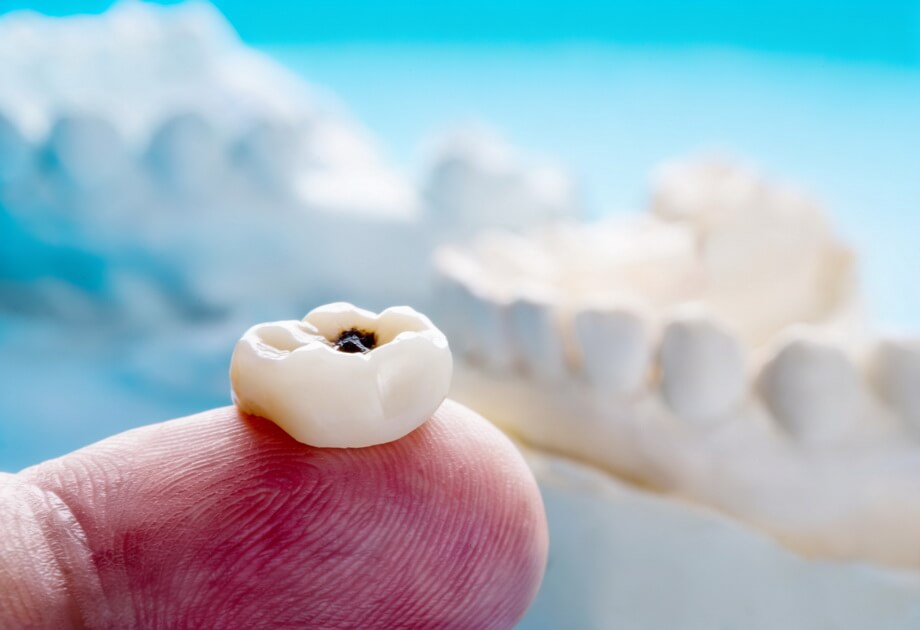
Many patients with dental crowns believe their teeth are completely protected, but the truth is that tooth decay under the crown is one of the most common problems in dentistry. If you notice a bad breath or a strange sensation under your crown, it could be an early warning sign that deserves immediate attention. In this article, Wonders Dentistry team explains everything you need to know about this problem and how to deal with it.
How does tooth decay occur under a crown?
Many people believe that dental prosthetics provide complete protection for the natural tooth underneath, but the reality is quite different. Crowns don’t fully protect the tooth; there’s always a gap between the crown edge and the gum tissue, and this gap is the main weak point.
Food debris and plaque (bacterial deposits) accumulate at this gap daily. Over time, bacteria gradually decay the natural tooth under the crown. Old crowns or those that don’t fit snugly against the gum line also create an ideal environment for bacteria and saliva to enter, accelerating the tooth decay process.
Why don’t patients notice decay under their crowns quickly?
This question puzzles many patients, and the answer lies in the nature of the restoration material itself. Metal and ceramic restorations provide excellent insulation, preventing pain until decay progresses and reaches the tooth’s nerve. Furthermore, decay under the restoration can spread silently without any visible signs.
Even more concerning is that the time between the onset of decay and the appearance of pain can extend to a full year or more, making early detection through regular dental checkups crucial.
The 6 Most Important Signs of Decay Under a Restoration
If you notice any of the following signs, be sure to see your dentist as soon as possible:
- Pain when chewing or applying pressure to the restoration, especially if it appears suddenly after a long period of absence.
- Sensitivity to hot and cold drinks under or around the restoration.
- A foul odor or taste emanating from under the restoration despite regular brushing.
- Redness or bleeding of the gums around the edge of the restoration when brushing.
- Pus or discharge from under the edge of the restoration, which is one of the most serious signs.
- Movement or looseness of the restoration when attempting to move it with the tongue indicates poor retention.
Complications of neglecting tooth decay under a restoration
Delaying treatment can turn a simple problem into a complex and costly crisis. Here’s what can happen when you neglect tooth decay under a restoration:
- Decay reaching the tooth’s nerve necessitates root canal treatment (nerve removal) before any further steps.
- Significant tooth decay makes placing a new restoration difficult or impossible.
- Fracture of the tooth under the restoration may lead to complete tooth extraction.
- Infection spreading to the bone requires surgical intervention to treat cysts and abscesses.
Why does decay occur under a restoration despite good oral hygiene?
You may take care of your teeth daily and still be surprised by decay under your restoration. This happens for reasons not always related to neglect:
- First reason: The restoration is not perfectly aligned with the gum line, leaving a small gap through which bacteria can enter.
- Second reason: The cement wears down over time, especially after 5 to 7 years from the date of placement.
- The third reason: Gradual gum recession due to aging or chronic inflammation, exposing part of the natural tooth.
- The fourth reason: Teeth grinding during sleep (bruxism), which creates microscopic fractures in the restoration, allowing bacteria to enter.
- The fifth reason: Pre-existing decay that was not completely removed before the first restoration was placed.
How does Wonders Dentistry diagnose tooth decay under a restoration?
The Wonders Dentistry team relies on a comprehensive diagnostic methodology that combines a thorough clinical examination of the gums and restoration margins with X-rays that clearly reveal the decay hidden under the restoration. Our team also uses 3D CBCT scans in complex cases to obtain a complete picture of the extent and severity of the decay before making any treatment decisions.
Treatment options available at Wonders Dentistry depending on the stage of decay
The dentist determines the treatment plan based on the stage of decay:
Mild case (superficial decay):
Carefully remove the restoration, then clean the decay and replace the old restoration if it is intact, or place a new restoration.
Moderate case (cavity reaching the nerve):
Removal of the crown, followed by root canal treatment, and finally, placement of a new crown to protect the tooth.
Advanced case (cavity affecting a large portion of the tooth):
Post and core grafting to strengthen the root, followed by placement of a new crown. In cases of extensive damage, dental implants may be the best option.
Final case (tooth completely decayed):
Extraction of the tooth, bone grafting if necessary, followed by dental implants as a permanent and aesthetic solution at Wonders Dentistry.
How to prevent tooth decay under a crown before it occurs?
Prevention is always better and less expensive than treatment. Here are the most important tips:
- Use dental floss specifically designed for crowns (Superfloss) daily to remove food debris from under the crown edge.
- Use a fluoride mouthwash once a day to strengthen the bond between the crown and the natural tooth.
- Visit your dentist every 6 months for an X-ray examination of the crown edges and early detection of any decay.
- Don’t delay a checkup at the first sign of sensitivity or movement in the crown; waiting a week is sufficient.
- Replace old crowns every 10 to 15 years, even if they appear healthy from the outside.
FAQs
How can I tell if decay under a crown has reached the nerve without an X-ray?
There are clinical signs that indicate this, most notably spontaneous pain (without an external cause), pain that persists after removing a heat or pressure stimulus, and swelling or an abscess around the crown. However, definitive confirmation requires an X-ray.
Can decay under a crown be cleaned without removing it?
No, in most cases, this isn’t possible to guarantee complete removal of decay and sterilization of the tooth. The restoration must be removed first. In some very simple cases, a topical treatment may suffice, but this is the exception, not the rule.
What types of dental restorations are least prone to decay underneath them?
Full ceramic restorations, manufactured with high precision, are the best in terms of seal and conformity to the gums. Zirconia restorations also feature very fine edges that reduce the chances of bacterial leakage.
Can a new restoration be placed over a decayed tooth without treatment?
This is a common mistake that should be avoided completely. Placing a new restoration over untreated decay accelerates the spread of decay and worsens the problem. The correct treatment always requires complete removal of the decay and sterilization of the tooth before any new restoration.