
Self-confidence begins with a smile, and to achieve a radiant smile, you must address any dental problems that affect your self-esteem. Dentistry has advanced significantly in recent years, offering a comprehensive solution for choosing the right dentures for your specific needs. These dentures come in fixed and removable options, ranging from complete to partial and immediate. Therefore, deciding to get dentures is not merely a cosmetic choice, but a crucial and therapeutic one. It will greatly impact your personality, comfort, and self-confidence. Continue reading to learn all the details about this topic and how to choose the right dentures for you.
What are Removable Dentures?
Dentures come in various types, including fixed and removable dentures. Removable dentures are generally preferred because they are easier to fit. Here are some key details:
Definition
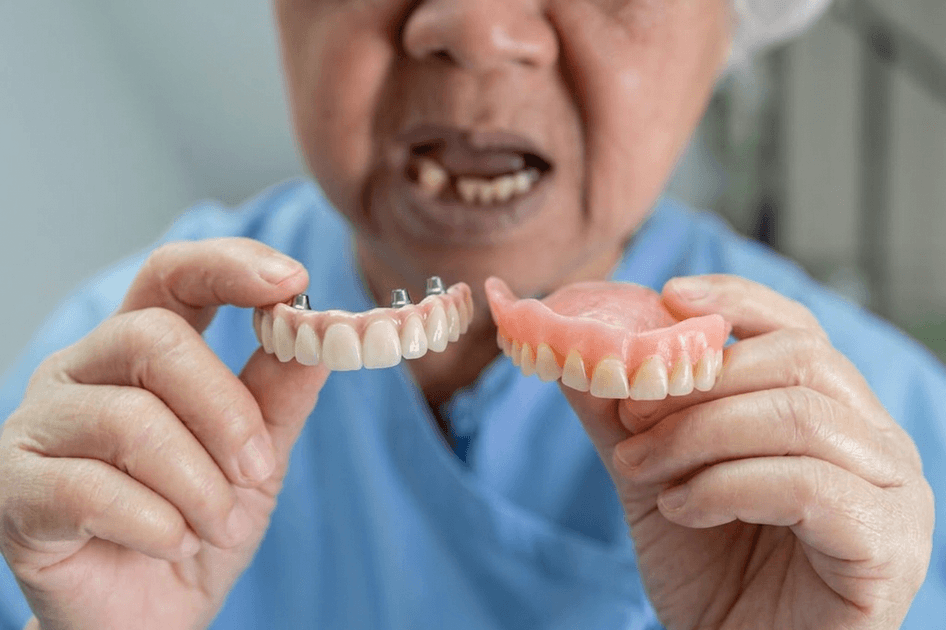
Removable dentures are artificial teeth made of metal or acrylic. They are used to replace missing natural teeth. There are complete dentures, partial dentures, and immediate dentures. Patients can remove and replace them frequently. They consist of a row of teeth fixed to a mold that mimics the shape of the gums, aiding in chewing and speaking.
Types of Removable Dentures
Removable dentures are the most common type. They are easy and quick to fit, and there are three main types:
- Complete Dentures: Dentists prescribe this type when a patient has lost all their teeth in both jaws. Usually, the difference between the denture and the natural gums is not noticeable.
- Partial Dentures: Dentists prescribe this type when a patient has lost some teeth. The partial denture is fitted to the missing area and secured with metal or cosmetic clasps.
- Immediate Dentures: These are fitted immediately after tooth extraction and are then adjusted as the gums heal.
Advantages of Removable Dentures
Removable dentures are a fundamental solution for many problems faced by people with missing teeth. Here are the most important advantages of removable dentures:
1- Low Initial Cost
Removable dentures are significantly less expensive than other solutions, making them accessible to many patients who cannot afford the higher costs of replacing missing teeth.
2- Non-Therapeutic and Non-Surgical
Removable dentures do not require surgical intervention or lengthy pre-treatment periods. In short, they are a quick and easy solution. The dentist simply takes the patient’s impressions, fabricates the dentures, and then they are easily fitted and secured.
3- Speed of Completion
One of the advantages of removable dentures is their speed. They don’t require much time or effort to make; impressions are taken and the dentures are made within two weeks to a month at most.
4- Adjustable and Repairable
This type of denture can be easily removed and adjusted if any errors occur. It can also be repaired if it is accidentally cut. It is easy to remove and replace.
5- Easy to clean and repair
This type allows for easy removal and cleaning, and can be maintained by the treating dentist in case of damage.
Disadvantages of Removable Dentures
Despite their numerous advantages, removable dentures present some challenges for some individuals, including:
Functional and Aesthetic Disadvantages
These disadvantages manifest in the form and function of the removable denture and include:
- Instability, which occurs during movement while speaking and chewing, and the denture may fall off when moved.
- Difficulty chewing, as the gums are weak, requiring more effort to apply pressure to the denture, resulting in insufficient force.
- Covering the roof of the mouth with the upper denture, which may lead to an unsightly appearance for some.
Health and Psychological Disadvantages
The fitting of removable dentures is accompanied by some health and psychological disadvantages, including:
- Gum irritation and inflammation, causing pain.
- Continuous bone loss in the jaw, leading to instability and weakening of the gums over time.
- An unnatural appearance, which can negatively impact the patient’s self-esteem and cause embarrassment about their appearance.
What are Fixed Dental Implants?
Removable dentures Some people opt for fixed dental implants because they offer advantages over removable dentures. Here are the most important details:
Definition
Fixed dental implants are one of the newest and most effective solutions for replacing missing teeth. They involve placing a titanium implant into the jawbone to act as the root of a natural tooth. A crown, bridge, or fixed prosthesis is then attached to the implant.
Unlike removable dentures, which rely on gum tissue, suction, or adhesives, fixed dental implants are a permanent and stable solution that resembles natural teeth in both appearance and function. Today, they are the preferred choice for those seeking a long-term replacement for missing teeth with complete restoration of aesthetic and functional function.
Fixed dental implants are used in cases of missing teeth, whether a single tooth, multiple teeth, or even an entire jaw, making them an advanced and effective alternative to traditional solutions.
Types of Fixed Dental Implants
The types of fixed dental implants vary depending on the number of missing teeth and the condition of the jawbone. They include:
Single Implant: To replace a single missing tooth
This type is used to replace only one tooth. A single implant is surgically placed into the jawbone, and then a crown that looks and feels exactly like a natural tooth is attached.
It is considered the ideal solution for preserving adjacent teeth without any damage or grinding that occurs with traditional dental bridges.
Implant-Supported Bridge: To replace several adjacent teeth with two or more implants
In cases where more than one adjacent tooth is missing, two or more implants are used to support a fixed bridge. This provides greater stability than traditional dental bridges and prevents pressure on adjacent natural teeth.
All-on-4 / All-on-6: A complete solution for the entire jaw using only 4 or 6 implants
This system is considered a revolution in the world of fixed dental implants, as it allows for the replacement of an entire jaw using only 4 or 6 implants that fully support a fixed prosthesis. It is a very strong alternative to removable dentures because it provides almost complete stability and chewing function very close to natural teeth.
Advantages of Fixed Dental Implants
1- Complete Stability – No Movement or Fallout
One of the most important advantages of fixed dental implants is that they are firmly anchored within the jawbone, making them completely stable while eating or speaking, unlike removable dentures which can move or cause embarrassment.
2- Chewing Power Up to 90-100%
Dental implants restore almost the natural ability to chew completely, allowing you to eat all types of food without restrictions. This is a significant difference compared to removable dentures, which reduce chewing efficiency.
3- Natural and Aesthetic Appearance
The crowns used in dental implants are designed to resemble natural teeth in color and shape, giving a very natural smile that boosts self-confidence.
4- Bone Preservation and Prevention of Atrophy
Dental implants stimulate the jawbone, preventing bone loss or atrophy over time. This is an advantage that traditional solutions like removable dentures do not offer.
5- No covering of the roof of the mouth
Unlike removable dentures that cover part of the roof of the mouth and cause an unpleasant sensation, dental implants do not interfere with the mouth, making the sensation completely natural.
Disadvantages of Fixed Dental Implants
High Initial Cost
Dental implants are more expensive than removable dentures, but they are considered a long-term investment due to their long lifespan.
Surgical Procedure Requiring Recovery Time
The implant procedure requires a minor surgical intervention, and the healing period can extend for several months before the final teeth are fitted.
Requires Sufficient Bone (or Bone Grafting)
In some cases, the patient may need a bone graft before implant surgery if the bone is weak or insufficient.
Not Suitable for Everyone (Medical Contraindications)
Certain conditions, such as uncontrolled chronic diseases, may preclude dental implant surgery.
Requires Meticulous Daily Care
Despite their stability, dental implants require thorough daily cleaning to maintain their integrity and prevent gum infections.
Direct Comparison: Removable Dentures vs. Fixed Implants
| Comparison Points | Removable Dentures Set | Fixed Dental Implant |
| Initial Cost | Up to 150,000 Egyptian pounds | Starts from 13,500 and goes up to 30,000 Egyptian pounds depending on the type of implant used |
| Long-term cost | The total cost over 10 years may increase 2-3 times | The total cost over 10-20 years is relatively the highest |
| Surgery | Not required | Required |
| Treatment duration | 8-12 weeks | 3-6 months |
| Stability | Removable | Very stable |
| Chewing force | Less and may limit the type of food you can eat | 100% natural-looking |
| Bone preservation | May accelerate bone loss | Preserves bone and prevents loss |
| Aesthetic appearance | Good | Very natural and looks like natural teeth |
| Impact on speech | Temporary difficulty at first | Completely natural after fitting |
| Covering the roof of the mouth | Covers the roof of the mouth and may look somewhat uncomfortable | Very comfortable and does not cover the roof of the mouth |
| Maintenance | High (daily extractions + cleaning) | Low, like natural teeth |
| Lifespan | Requires periodic replacement or adjustment | Permanent for many years |
What to choose? Decision criteria based on your situation:
Removable dentures are suitable for you if:
- Your budget is very limited right now (knowing that you will need to replace them later)
- Your jawbone is very weak and unsuitable for dental implants, even with bone grafting
- You have medical contraindications that prevent surgery
- You prefer a non-surgical solution despite its functional limitations
This option is often used as a temporary or cost-effective solution compared to fixed dental implants.
Fixed dental implants are suitable for you if:
- You are looking for a permanent and stable solution that lasts for many years
- You want to eat everything you like without fear of the dentures falling out
- You want a natural appearance that boosts your self-confidence
- You have sufficient healthy bone or are willing to undergo bone grafting
- You are looking for a long-term investment (the higher initial cost pays off over the years)
Wonders Dentistry opinion: The ideal solution in both cases
We address the shortcomings of removable dentures. At Wonders Dentistry, the removable denture experience is enhanced through precise designs that minimize movement and maximize comfort, with regular follow-up to ensure optimal performance. We make fixed implants accessible to you.
Our clinic offers fixed dental implant solutions using modern techniques that reduce pain and treatment time, along with payment plans and flexible payment options that make the decision easier for the patient without financial strain.
FAQs
How can I know if dental implants are right for me?
This is determined through a comprehensive X-ray and jaw examination to assess bone density and gum condition and determine if fixed dental implants are a suitable option.
What is the difference in total cost between dentures and implants in the long run?
Although removable dentures are less expensive initially, implants are generally less expensive in the long run because they last for many years without needing replacement.
Which is better in terms of stability and comfort while eating?
Without a doubt, fixed dental implants are much better because they provide complete stability while eating compared to removable dentures.
Is there pain after getting fixed implants compared to dentures?
Pain after implant placement is usually mild and temporary, while removable dentures can cause permanent gum irritation in some patients.
Can removable dentures be converted to fixed implants in the future?
Yes, you can start with removable dentures and then move on to fixed dental implants later when your health improves or your budget allows.