


Fixed dental restorations are a long-term alternative for replacing partially damaged teeth, unlike removable dental prostheses that treat areas where teeth are completely missing.
This dental procedure (fixed restorations) has many benefits such as restoring function, enhancing aesthetics, and strengthening dental health. Whether you have lost one tooth or several teeth, fixed dental restorations can help you regain your smile and confidence in life, including the endocrown procedure that reinforces teeth damaged by tooth decay and that required root canal treatment.
Root canal treatment, also known as endodontic treatment, is one of the common dental procedures aimed at saving a damaged tooth. However, after this treatment, the tooth becomes more fragile and less able to withstand daily pressures, which makes it in need of additional support.
Here comes the role of the endocrown, which is considered one of the modern and effective solutions to protect the endodontically treated tooth and restore its function and aesthetic appearance. In this article, we will discuss everything you need to know about the endocrown in terms of benefits, types, installation steps, and longevity.
What is an Endocrown?
It is a type of dental crown used to restore teeth that have undergone root canal treatment.
During root canal treatment, the infected pulp is removed from inside the tooth, and the root canals are cleaned, shaped, and filled with gutta-percha. Due to tooth decay reaching the root canal and requiring nerve treatment, the tooth becomes weakened. Therefore, the ideal solution to strengthen the tooth is a post and crown, where a post is placed inside the root canal filled with gutta-percha, followed by a white filling, and then the tooth is prepared for a crown. This procedure provides sufficient space for the filling to adhere to the tooth and offers support to receive the crown.
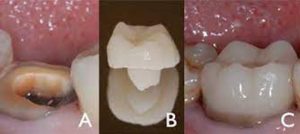
However, the more advanced solution is the (Endocrown): the difference is that in this procedure, after treating the tooth, it is prepared in a specific way to make it flat so that a fixed restoration made of zirconia or strong E-max can be placed. This restoration has an extension that goes into the pulp chamber as shown in the image below.
The difference between Endocrown and traditional crowns
Traditional crowns often require a post to be placed inside the root canal for retention, and they require removing a larger amount of the natural tooth structure. In contrast, the endocrown is fixed directly inside the pulp chamber after cleaning and shaping it, preserving as much healthy tooth structure as possible. Its design also provides additional support and reduces the chances of tooth fracture or restoration failure.
Why does an endodontically treated tooth need an Endocrown?
Weak structure after root canal treatment: when root canal treatment is performed, the nerve tissues and blood vessels inside the tooth are removed, which leads to drying of the tooth and weakening it, making it more prone to fracture.
Loss of internal nourishment: natural teeth receive part of their nourishment from the nerves and blood vessels inside the pulp, and after their removal, this nourishment stops, leading to brittleness of the tooth structure over time.
Thin tooth walls: in many cases, a large portion of the tooth structure is removed during treatment, resulting in thin walls that need immediate support to avoid fractures or collapse.

How is the Endocrown prepared?
- Tooth preparation: the tooth is shortened to make it flat to receive the restoration as shown in point A in the image.
- Preparation of the pulp chamber area: the pulp area is prepared after root canal treatment by removing any small sharp areas and removing unsupported enamel areas without removing much of the unaffected tooth structure. Then, a very thin layer of flowable composite is applied and cured with blue light to ensure no sharp edges remain and to make the area rounded to receive the extension of the endocrown.
- Taking impressions of the tooth: in this plan, we use addition silicone impression material (putty and light body), then place it in the patient’s mouth to capture the impression. The impression can also be taken using an intraoral scanner available at Wonders dentistry, which provides comfort for the patient and faster results compared to traditional impressions.
- Sending the impression to the lab to fabricate the restoration.
- Trying the restoration: we ensure that the restoration is properly made and fits the tooth without any interference.
- Polishing and preparing the restoration.
- Cementing the restoration using adhesive cement for fixed restorations:
Advantages of Endocrown
- It utilizes the pulp chamber compared to the alternative solution (post and crown).
- Compatible with the modern concept of minimal invasive dentistry, which focuses on removing as little healthy tooth structure as possible to achieve restoration goals.
- A strong restoration with a longer lifespan compared to post and crown.
- Provides a more aesthetic appearance compared to other methods.
- Complete protection of the tooth: the endocrown covers the entire tooth and provides both internal and external support, preventing fracture or damage.
- Long lifespan: with proper care, the endocrown can last for many years without the need for replacement.
- Natural appearance: the endocrown is made from advanced materials that mimic the color and shape of natural teeth, giving it an ideal aesthetic look.
Risks of not placing an Endocrown
- Tooth fracture: endodontically treated teeth left without additional support are more prone to fracture, especially أثناء chewing or eating hard foods.
- Bacterial leakage: temporary or poorly fitted restorations may allow bacteria to seep into the tooth, leading to new infections and failure of previous treatment.
- Higher cost than fillings: due to manufacturing techniques and materials used, the cost of an endocrown may be higher than traditional fillings.
- Requires tooth reduction: although it preserves more tooth structure than traditional crowns, the endocrown still requires precise tooth preparation.
Types of Endocrown
According to material:
- Zirconia: characterized by high strength and resistance to wear, making it ideal for endure chewing forces, especially in posterior teeth.
- E-max: known for its high aesthetics and translucency similar to natural teeth, so it is usually used in anterior teeth or cases requiring superior aesthetics.
- Porcelain-fused-to-metal: combines the strength of metal with the aesthetics of porcelain, but is less commonly used in endocrowns compared to zirconia and E-max.
According to design:
- With internal support: some endocrowns are designed with a small post-like extension to increase retention inside the pulp chamber in cases of very thin walls.
- Without support: the standard design that is fixed directly inside the pulp chamber without additional support.
Care tips after placement
Practice good oral hygiene habits: maintain a consistent oral hygiene routine by brushing your teeth at least twice a day and using dental floss daily. Pay close attention to the area around the crown and ensure plaque removal.
Use appropriate oral care products: choose a soft-bristled toothbrush to avoid damaging the crown or irritating the gums.
Avoid frequently eating hard objects: consider habits that place excessive force on the restoration, such as grinding your teeth or biting hard objects (like ice and pens) or using your teeth as tools, as these can cause the crown to crack, break, or dislodge.
Attend regular dental check-ups: visit your dentist for routine examinations and cleanings. During these visits, your dentist can assess the condition of the crown, check its fit, and address any potential issues early.
Address any concerns immediately: if you feel any discomfort or sensitivity or notice changes in the appearance of the crown, contact your dentist immediately. Early intervention can prevent further damage or complications.
Consider using a night guard: if you grind or clench your teeth, discuss the possibility of using a night guard with your dentist. A night guard can protect your crown from forces generated during teeth grinding.
How long does an Endocrown last?
The lifespan of an endocrown depends on the quality of materials, the dentist’s skill, and the patient’s care of the restoration. With proper care, it may last from 10 to 15 years or more.
Can it be placed on any tooth?
Endocrowns are usually used for posterior teeth (molars) that have undergone root canal treatment due to their design and strength. However, they can also be used for anterior teeth in some cases, provided there is sufficient structure and proper retention.
Final thoughts
The endocrown is an advanced treatment option that enhances the protection of endodontically treated teeth, providing long-lasting support and strength while preserving the aesthetic appearance of the smile. If you have undergone root canal treatment, do not hesitate to consult your dentist about the possibility of placing an endocrown as a long-term solution to protect your teeth and restore your confidence in your smile.
Restore your smile with confidence… take your first step with us at Wonders dentistry. Book your consultation now.
FAQs
Why is the “Endocrown” considered better than a traditional crown after root canal treatment?
Traditional crowns often require placing a post inside the tooth root, which may weaken the root and lead to future fractures. In contrast, the endocrown is a monolithic restoration that is fixed directly inside the pulp chamber and the remaining tooth walls. This approach preserves more natural tooth structure, making the tooth more resistant to strong chewing forces.
Is the “Endocrown” strong enough for posterior teeth?
Absolutely, it is specifically designed for molars. Since it is milled from a single solid block such as E-max or zirconia, it has no weak نقاط. The wide bonding surface داخل the pulp chamber provides exceptional retention, making it the gold standard for restoring severely damaged molars after root canal treatment.
How long does the Endocrown procedure take?
Thanks to digital technologies at Wonders dentistry, the process is very fast and efficient. Using an intraoral scanner, we create a 3D map of your tooth within seconds. In many cases, the endocrown can be designed, fabricated, and placed in a short time compared to traditional crowns, reducing the number of visits and the need for temporary restorations.
Can an Endocrown be placed on any tooth that had a root canal?
The endocrown is an ideal solution for molars and premolars, but it requires sufficient remaining tooth structure for success. If the tooth is fractured below the gum level, a different treatment protocol may be needed. Our specialists use digital imaging to evaluate the “mechanical” condition of the tooth and ensure that the endocrown is the safest and most durable solution for you.