
Around half of adults suffer from varying degrees of gum recession, and this problem increases significantly with age and poor oral care. When gum tissue recedes, not only are tooth roots exposed, but the risk of tooth sensitivity and root inflammation increases, making gum grafting surgery sometimes necessary to maintain dental health and longevity.
Gum grafting, can gums be grafted? The gum is the thin pink layer that covers tooth roots and supplies the mouth with blood nourishment, maintaining its health and vitality and protecting against tooth sensitivity and gum inflammation. Over time, this gum may recede slightly, exposing the covered roots, which increases sensitivity and pain.
Gum recession has many causes such as aging, but sometimes it is the result of damage to the gum caused by improper tooth brushing or neglecting oral and gum health, leading to gum inflammation and tartar buildup, which is also accompanied by bone loss around the teeth and many other causes that may lead to recession spreading to more than one tooth.
In some cases, such as gum recession in areas visible when smiling, gum grafting is an excellent solution to restore the gum shape and function again.
What is surgical gum grafting and what are its steps?
Gum grafting is a surgery aimed at restoring the gum after it has receded. This type of gum grafting is performed by dentists specialized in gum diseases in general and gum grafting in particular, who communicate with you in the early visits to determine the area to be grafted, the suitable type of surgery for the area, and the best gum graft options available for your condition.
The gum grafting procedure consists of two parts: gum grafting and gum tissue graft.
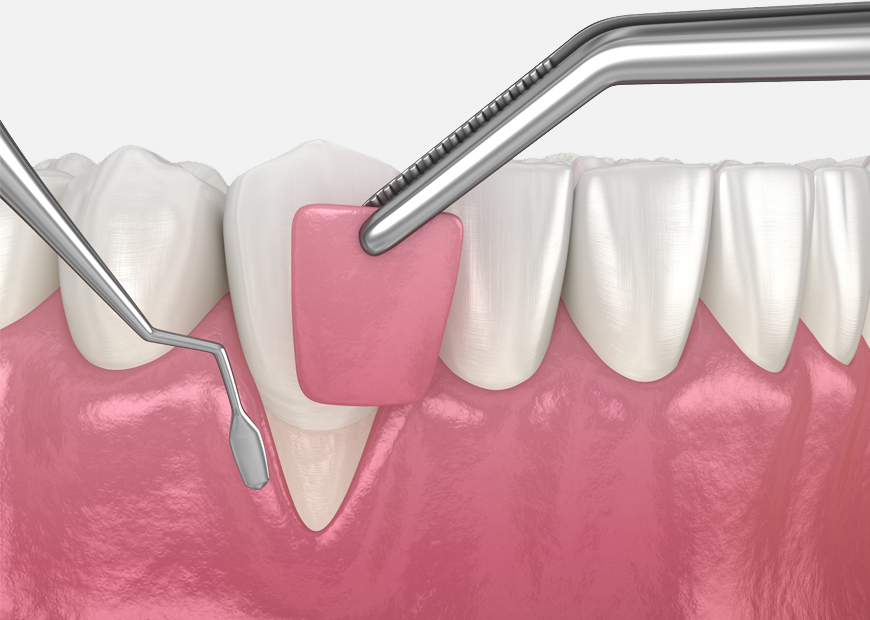
Gum grafting means that tissue is taken from specific areas in the mouth or tissue similar to the natural gum is placed and fixed in the area that needs surgical correction. First, the area to be grafted is cleaned to remove any inflammation or tartar buildup, then a few local anesthetic injections are given, and using a scalpel, precise incisions are made in the gum of adjacent teeth to prepare the site for grafting.
Types of gum grafting
There are several types of gum grafting, including:
Free gingival graft:
In this type, the prepared area is grafted using tissue taken from the mouth to increase the amount of gum in the affected area, such as in people who have thin gum tissue.
Connective tissue graft:
This involves taking the thin layer underneath the visible layer and placing it in the grafted area. After healing, the gum grows again over this layer, and it is one of the most commonly used grafts in cases of gum recession.
Lateral graft:
In this type, gum tissue is taken from adjacent teeth and the affected area is covered in a way that is not noticeable. This is used when only one tooth is affected next to teeth that have sufficient healthy gum.
The gum graft is fixed in place using fine sutures, and a dressing may be placed around the grafted area until complete healing occurs.
Causes for needing gum grafting
Gum grafting is used in several necessary cases, including severe gum recession that exposes tooth roots and increases tooth sensitivity, and chronic gum diseases that do not respond to conservative treatments. It is also used after periodontal injuries or aggressive tooth brushing that damages tissues. In addition, it is used to improve smile aesthetics, lengthen short teeth, or achieve gum line symmetry around teeth.
Advantages of gum grafting
Gum grafting is a precise restorative treatment that restores natural balance to gums and teeth, providing both functional and aesthetic benefits:
- Protection of exposed tooth roots: When gum recession occurs, tooth roots become exposed and more vulnerable to wear, sensitivity, and tooth decay. Gum grafting covers exposed roots and protects them from external factors.
- Reduction or elimination of tooth sensitivity: After root coverage, tooth response to hot or cold stimuli decreases significantly, reducing pain and sensitivity.
- Improved smile appearance: The procedure helps correct gum line symmetry and hide gaps caused by recession, giving a healthy and natural smile.
- Additional support for teeth: Gum grafting strengthens tooth stability and reduces the risk of movement or loss, especially in weak gum cases.
- Prevention of further gum recession: If performed successfully with proper care, grafting can stop future gum deterioration and stabilize it in a healthy position.
- Long-term solution with proper care: With good oral hygiene and regular dental visits, results can last for years without repeat procedures.
Disadvantages of gum grafting
Although effective, gum grafting is not completely free from challenges and possible complications:
- Pain and swelling after surgery: The patient may feel discomfort or mild to moderate pain, along with localized swelling, which usually resolves within days with prescribed medications.
- Possible graft failure in some cases: Especially in smokers or uncontrolled diabetic patients, the graft may not integrate properly or may be rejected.
- Minor bleeding or inflammation in early days: Especially if post-operative instructions are not followed or direct trauma occurs at the graft site.
- Need for donor tissue from the palate: In some graft types, tissue is taken from the roof of the mouth, which may cause additional discomfort during healing.
- Unexpected aesthetic results sometimes: In cases with severe gum loss, gums may not fully return to their original natural appearance.
- Relatively high cost: Gum grafting is an advanced procedure requiring expertise and precise tools, making it more expensive than traditional treatments.
How long does gum grafting take and when is full recovery achieved?
It is not a complex surgical procedure requiring a long time, as it is usually completed within a standard dental visit. However, what distinguishes it is the post-operative phase, which is crucial for success.
Recovery occurs within a few weeks, and patients may experience some pain and swelling due to preparation of the graft site. However, dressing, painkillers, anti-swelling medications, and antibiotics prescribed by your dentist help resolve these symptoms quickly.
To ensure fast recovery, instructions must be followed carefully to achieve the best results.
Gum Grafting Surgery Steps
The procedure is performed according to the following steps:
- Comprehensive examination and tests to understand the condition of the gums, bones, and roots.
- 3D imaging for precise planning of graft placement sites.
- Local anesthesia to provide patient comfort.
- Harvesting donor tissue if necessary.
- Preparing the recipient area and cleaning it thoroughly.
- Fixation of the surgical graft using fine sutures.
- Post-operative instructions to prevent infection and reduce gum discomfort.
- Regular follow-ups to monitor healing and adjust care.
- Home care is very important during the following weeks to ensure the success of the procedure.
Post-operative care tips
Here we come to how to take care after gum grafting to ensure the success of the procedure, and this is your main role, which is no less important than the role of the dental surgeon.
- This type of surgery deals with very delicate tissues that are quickly affected by any damage. Therefore, you must, for example, avoid smoking, eating hard foods, and drinking hot beverages until proper healing occurs, so that the graft does not deteriorate or the surrounding tissues become inflamed, which may lead to failure of the grafting procedure.
- You must also follow the instructions for brushing around this specific area, as it may be necessary to avoid brushing the teeth and rely only on mouthwash for a period determined by your treating dentist.
- Finally, you should use painkillers and anti-swelling medications according to the instructions specifically given to you.
- Do not forget to visit your dentist after the procedure at the scheduled time, which is usually one week after the surgery, so that the graft area can be carefully examined and to ensure your commitment to the instructions and guidelines. During this visit, the medical dressing and sutures are also removed, and the grafted area is cleaned properly. If there are some deposits present, they are removed to ensure the success of the grafting procedure. Another visit may be required afterward, during which you are informed that complete healing has occurred and the procedure was successful, and you can treat the area normally while continuing to care for gum and oral health.
Conclusion
Gum grafting is an effective step to restore the health of your mouth and gums, especially when suffering from recession that affects tooth roots and smile appearance. Modern techniques and precise planning make it a targeted and successful procedure.
At Wonders dentistry, we are proud to offer the latest gum grafting techniques using biological materials and precise laser technologies, with a specialized team that cares about your comfort and long-term results. Start today toward a healthy and well-aligned smile — book your consultation now, because early care makes the difference.
FAQs
Is gum grafting only for cosmetic purposes?
Although it significantly improves the appearance of the smile, gum grafting is primarily a preventive procedure. When the gums recede, the tooth root becomes exposed to bacteria and acids, leading to root decay and tooth loss. Grafting strengthens the “attached gum,” creating a strong barrier that protects the bone and prevents further tissue recession.
Where is the new tissue taken from in gum grafting?
There are several modern options; a small part of tissue can be taken from the palate, or donor matrices and growth-stimulating materials can be used. At Wonders dentistry, we prefer minimally invasive techniques to ensure the fastest healing period and the best color and shape match with your natural gums.
What is the expected recovery time after gum graft surgery?
Thanks to microsurgery techniques, recovery is much faster than before. Most patients can return to work within 24 to 48 hours. Complete biological integration of the tissue takes about two weeks. During this period, we provide special care protocols and PRF (Platelet-Rich Fibrin) technology to reduce discomfort and speed up results.
Can I avoid grafting if I notice early gum recession?
Yes, early intervention is the key. If recession is caused by aggressive brushing or teeth grinding, adjusting these habits and using a night guard can stop the process. However, once tissue is actually lost, grafting remains the only solution to restore the gum margin and fully cover exposed roots to eliminate sensitivity permanently.